As a new instructor, starting with clear learning goals can make course planning more focused and effective. In the first stage of Backward Design, the focus is on getting clear about what you want students to learn. Before diving into activities or assessments, take a step back and ask, “What really matters most in this course?”
Step 1: Identify Enduring Understandings
Wiggins and McTighe recommend reflecting on each the following three questions to help you distinguish between content that is worth students being familiar with from the important ideas, understandings, and skills that students should retain long after they leave the course.
What should participants hear, read, view, explore, or otherwise encounter?
This is the foundational layer—content that students will be exposed to during the course, even if they don’t need to master it. Think of it as background knowledge or context: readings, videos, or ideas that help set the stage for deeper learning. It’s helpful, but not essential for long-term retention.
What knowledge and skills should participants master?
Here, you’re identifying the core competencies students should walk away with. These are the facts, concepts, methods, and processes they’ll need to apply both in your course and beyond. Ask yourself: What should students be able to do confidently and independently by the end?
What are big ideas and important understandings participants should retain?
These are the enduring understandings—the insights you hope students will remember long after the course ends. They reflect the heart of your discipline and help students make meaning of what they’ve learned. These ideas should be transferable, thought-provoking, and worth revisiting over time.
Step 2: Write Learning Objectives
With answers to the questions from step 1 above in hand, you are ready to write learning objectives for your course. Learning objectives—sometimes called learning outcomes—are clear, specific statements about what students should know or be able to do after instruction. Unlike the broad learning goals of a course, learning objectives give you concrete criteria to assess whether students are achieving those goals.
Learning objectives are useful for instructors and students alike. Learning objectives help you, the instructor, make decisions that ensure that every part of your course is purposefully aligned to support student learning. And for students, learning objectives clearly communicate what is expected of them, what success looks like, and empowers them to take more ownership over their learning.
SMART Learning Objectives
When you are first getting started, with writing learning objectives it can be helpful to follow the format, “By the end of this [unit/lesson/module], students will […].” The most effective learning objectives are those that are Specific, Measurable, Achievable, Relevant, and Time-bound (SMART, Fig. 1).
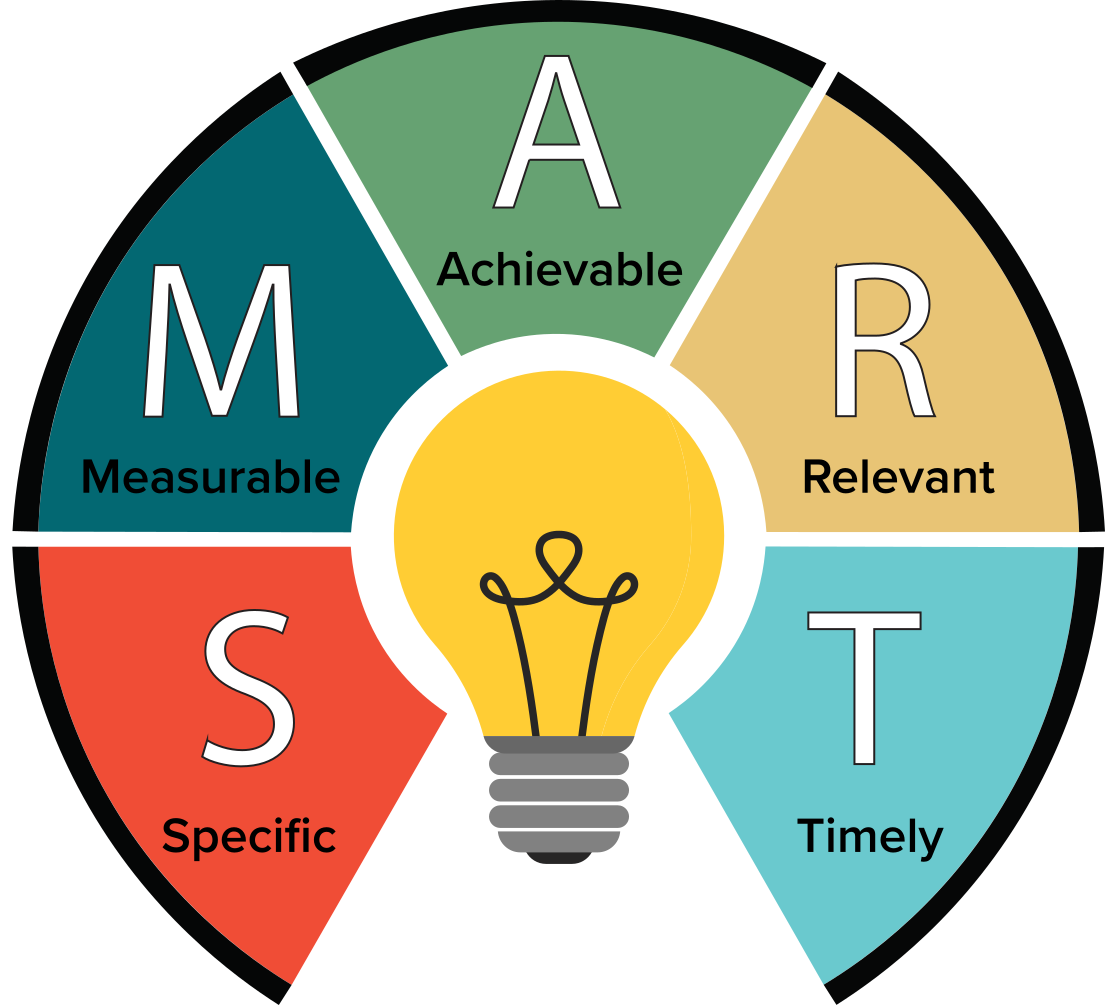
Specific
Start by breaking down broad topics, concepts, and/or skills into clear, manageable pieces. Then be explicit about what the desired outcomes associated with each of those pieces.
Measurable
Learning objectives need to focus on what students say or do—things we can observe and therefore measure. Avoid vague verbs like “understand” or “know,” use observable actions like “describe,” “analyze,” or “create” to make progress easier to evaluate.
Achievable
Objectives should be realistic given your students’ background, readiness, and the time available. Think about the level of your course—what’s appropriate for first-year students might look very different from what’s expected in a graduate seminar.
Relevant
Objectives should be meaningful to the learner and address a specific need or skill. Instead of saying “write a paper,” describe what the paper should demonstrate—like the ability to construct a well-supported argument or synthesize multiple sources.
Timely
If timing matters, say so! Including a timeframe (e.g., “by the end of the unit”) helps clarify expectations and gives both instructors and students a way to track progress.
Writing SMART Learning Objectives
Writing SMART objectives can be tricky at first, particularly when trying to determine what aspects of learning are readily measurable. As you write your learning objectives, it helps to think about the kind of evidence students will produce to show they’ve met the goal. In other words, how will you know they’ve “got it”? A strong learning objective usually has two parts:
- an action verb that clearly describes what students will do, and
- the object—the specific knowledge, skill, or concept they’ll be working with.
Examples
Weak learning objective: Students will appreciate 18th and 19th century texts.
Stronger learning objective: Students will be able to critique 18th and 19th century texts in terms of authenticity and reliability.
Additional Resources
- Bloom’s Taxonomy: A Crash Course for Online Course Creators (useful for any instructor, not just online)
- Learning Outcomes Review Checklist from Cornell University
- Course Design from the Center for teaching excellence at Boston College